

What Actually Broke When Labeling Egocentric Hands
I spent a stretch of this summer labeling first-person kitchen video: where the hands touch things, how long a grip lasts, and how to group those grips into something closer to a sub-task. Here is the overall layout I ended up with — hand geometry, contact-driven split, then a separate retarget path into simulation:
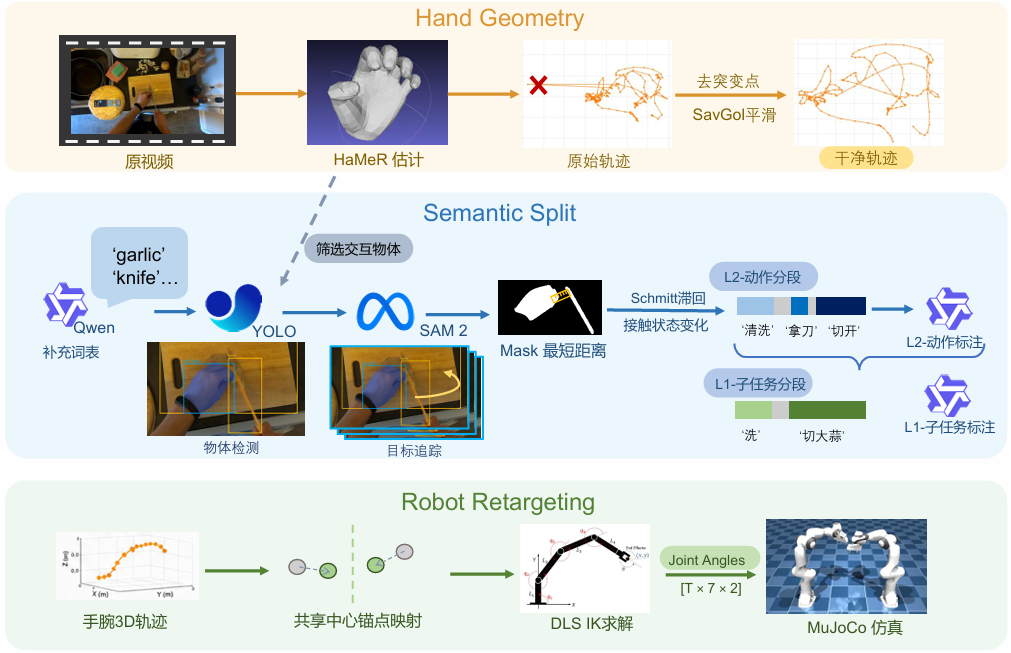
The rest of this post is not a walkthrough of that diagram. It is about what failed when the obvious baselines met real footage. No repo link.
Contact: boxes looked fine until they didn’t
I tried three ways to decide “hand is touching object” on a ~5‑minute clip (1500 frames at 5 Hz):
| Variant | Flickers | Contact segments | Segments under 0.5 s | Mean length (s) |
|---|---|---|---|---|
| A · Box IoU | 282 | 142 | 73 | 1.25 |
| B · Raw mask distance | 216 | 109 | 45 | 1.86 |
| C · Distance + smoothing + hysteresis | 58 | 30 | 0 | 7.11 |
A is the usual box overlap rule. It chatters: hands and objects graze in image space, IoU flips on and off, and you get a pile of short scraps.
B already helps — measuring mask distance instead of box IoU cuts a lot of junk. But a hard threshold still flickers when the hand hovers near a board or a knife.
C adds light temporal filtering and Schmitt-style hysteresis (plus bridging tiny gaps). Flickers drop by ~73% vs B; sub‑half‑second scraps go to zero; average contact length jumps to about seven seconds. That is closer to “one continuous grip” than “one lucky IoU frame.”
Short clips pointed the same way. The lesson was boring and useful: for ego hands, geometry beats boxes, and temporal glue beats a single threshold.
Sub-tasks: similarity merge glued the wrong things
For grouping contacts into sub-tasks I compared two ideas:
| Variant | # Sub-tasks | Cross-object merges | “and” in captions |
|---|---|---|---|
| A · Fixed blocks + text similarity merge | 15 | 5 (33%) | 16 |
| B · Split on long gaps / object change | 26 | 0 | 1 |
A looked clean on paper — chunk the video, merge neighbors with similar captions. In practice it glued a ~50 s stretch into one “sub-task” that opened a bottle, put down a cup, used the fridge, and moved a pan. The caption became a laundry list of “and … and …”.
B is duller: cut when the contact object changes, or when there is a long idle gap. Cross-object merges went to zero. Captions stopped lying about doing five chores at once.
The sticky cut I refused to “fix”
Contact-based cuts have a cost. Long, close work — continuous knife on garlic, standing at a sink — stays one geometric contact even when a human would name several micro-actions. One garlic-cutting stretch ran ~63 s with almost no flicker; another sink stretch ~48 s.
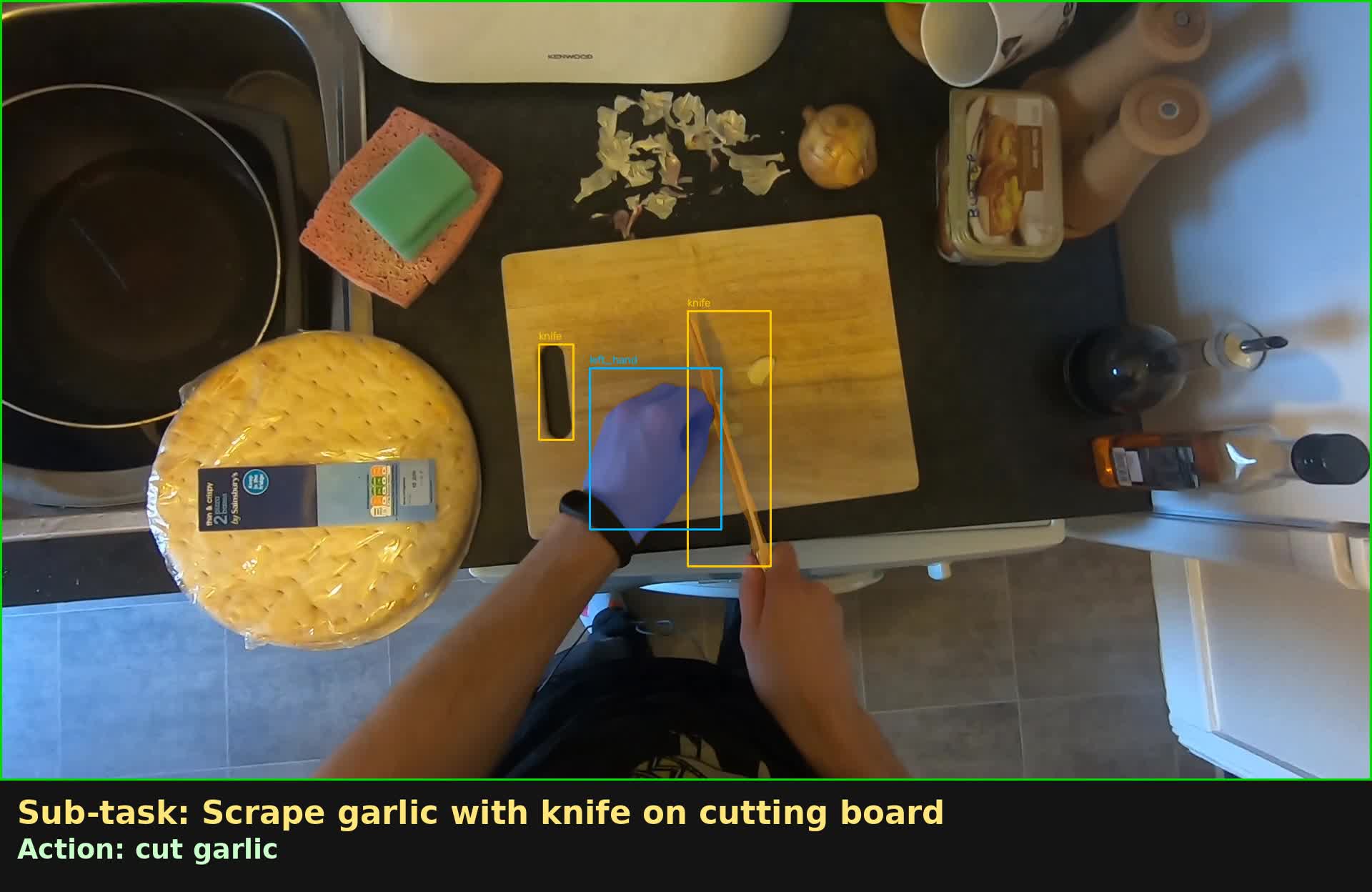
I tried the tempting fix: ask a VLM to re-slice anything longer than N seconds. Equal-time splits looked arbitrary; the model also invented tiny actions that were not in the video. So I dropped that path. If the geometry says one continuous contact, I keep one segment and let a higher-level caption summarize it. Better an honest coarse label than a polished wrong one.
Takeaways
- Box IoU is too twitchy for ego hand–object contact.
- Mask distance helps; hysteresis and short-gap bridging help more.
- Caption similarity is a bad glue for sub-tasks when objects keep changing.
- Ultra-long contacts are often correct under a geometric definition — do not paper over them with an unstable second-stage cut.
If you only want one number: on this clip, going from raw mask distance to filtered contact cut flickers from 216 → 58 and wiped out the sub‑0.5 s scraps entirely.
← Back to blog